
The work that eats your week can run itself.
I build the role that does this work for you, and the one screen you run it from.
- Platform already in production at a large European group
- Infrastructure certified to SOC 2, ISO 27001 and ISO 42001
- Month two free if the role is not running
The result
Monday, 8am. You already know everything.
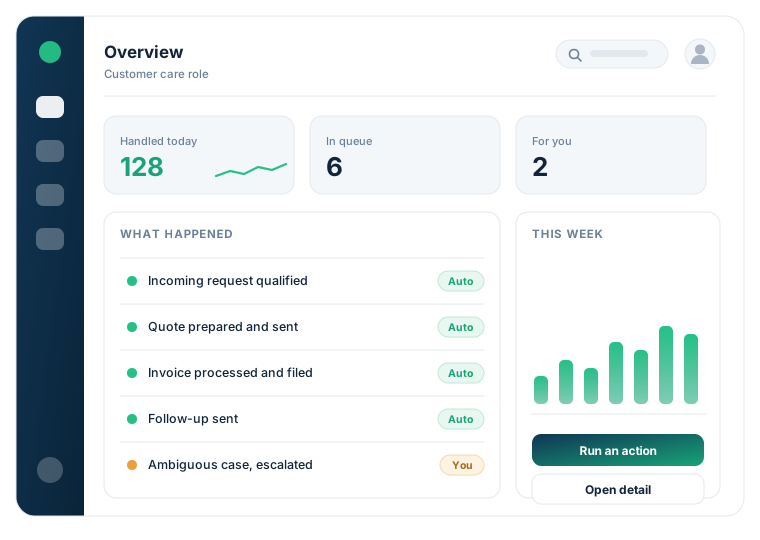
You open one screen and it's all there: what's done, what's moving, and the two or three things that genuinely need you. No spreadsheet to refresh, no colleague to chase for a number.
The rest runs while you decide. Follow-ups go out, files complete themselves, requests reach the right person. You stop chasing your business and start running it, whether you're five people or five hundred.
The repetitive work skips you
Anything that follows a known rule gets done on its own, every time, with nobody watching.
Only real decisions reach you
What needs judgment arrives prepared and summarised, in front of the right person.
See it all, act in one place
The live state of your business, and the buttons to act on it. Nobody juggles five tools anymore.
You stay in control
Every action is logged and reversible. Nothing binding goes out without your say.
What I ship
A role that runs on its own, and that you pilot from one screen.
Three roles cover most of the ground: sales, customer care, back office. For each one the result is the same: the work gets done, you see everything, and you only step in where your judgment counts. Behind it sit workflows, an agent where judgment is needed, and a dashboard. That's my job, not yours.
Sales & Marketing
Every lead followed up, nothing forgotten
- AgentQualifies, researches, follows upKnows your offers, your pricing rules and your tone of voice
- Workflows behind itRouting, enrichment, CRM syncDeterministic: same input, same result, every time
- DashboardPipeline cockpitPilot the agent, read every conversation, step in when it matters
Customer Care
Customers served, even on a Sunday night
- AgentResolves, grounded in your knowledge baseAnswers in your customer's language, escalates the moment it's unsure
- Workflows behind itTriage, routing, SLA timers, escalation pathsThe rules never drift, and every step is logged
- DashboardService deskLive queue health, and take over any conversation in one click
Operations & Finance
Files that close without you
- WorkflowsInvoice processing, reconciliation, onboardingExtract, validate, post, with a full audit trail
- AgentException handlerPicks up only what the rules couldn't close on their own
- DashboardOps control roomExceptions surfaced, reruns triggered in place
Your cockpit
Your whole business on one screen.
What is actually happening, what is waiting on a decision, and the buttons to act, without opening five other tools. Ask your data a question and it answers. Your team only has one screen to learn.
None of it is hand rolled. I build on a licensed enterprise agent platform, already proven at scale, and ship it under your brand. The hard infrastructure is solved on day one, so my time goes into your business instead of plumbing.
The intelligent dashboard Always
- See the state of the business in real time
- Makes your data talk, instead of sitting in five systems
- Act from the same screen: trigger a run, ask an agent, update a record
- Per-user permissions: who sees what, and who can trigger what
- Reachable by your whole team from anywhere, nothing to install or host
Deterministic workflows When the work repeats
- Triggered by an event, not a prompt
- Connected to the systems you already run
- Validation, retries, and a full audit trail
- Same input, same output, every time
- The high-volume, repetitive work, done without anyone watching
AI agents When it needs judgment
- Reading, weighing, drafting, deciding what to escalate
- Grounded in your context and your policies
- Evaluated before they ship, monitored after
- Human in the loop exactly where it matters
- Every run is logged, so you can see why it decided that
The platform in production
A large European group took a customer-onboarding agent live in a few weeks.
That is the platform your dashboard runs on, already proven by thousands of customers who have talked to its AI sales agent. In your business, budget 2 to 4 weeks for the first thing to go live: that time goes into understanding how you actually work, not into building the technology.

Who you'll be working with
Tom Guisgand
Fifteen years in process and customer experience design, the last few spent putting AI agents into production at consumer scale inside a large European organisation. I've seen what survives contact with real customers, and what quietly gets switched off.
Now I build the same thing for Belgian companies, in French, Dutch and English.
See my background on LinkedInHow we get there
Automate first. Add judgment only where the rule runs out.
Frame
Pick the work with volume and a clear trigger. Decide together what's a rule and what needs judgment.
Automate
Ship the deterministic path first, in 2–4 weeks. It pays for itself before any model is involved.
Add judgment
Introduce agents only where the rule runs out. Evaluated before they ship, monitored after.
Put it in service
The role runs, and you run your team from one screen, the way you pictured it. The next one is faster than the first.
Sound familiar?
You tried. It half-worked. Then it stalled.
Maybe you connected ChatGPT or Claude to your mailbox and it was impressive for a week. Maybe you tried something bigger and it quietly died. Or maybe you look at all of it and genuinely don't know where to start.
All three are the normal place to be. None of them mean the tools are bad, or that you did it wrong. Here is where people actually get stuck.
You don't know what to automate first
Everything looks automatable, nothing feels safe to start with, so nothing ships. The hardest part isn't the technology, it's choosing.
We start where there is volume, a clear trigger and a willing owner.
Brilliant in the demo, then Monday happened
The first test is impressive. Then the exceptions arrive, and the exceptions turn out to be most of the job.
Rules cover the known cases. The agent only takes what is left.
You can't trust it with anything that costs money
Same question on Tuesday, different answer on Thursday. Fine for drafting a reply. Not fine for a price, a date or a commitment.
Deterministic where it matters. A number never comes from a model.
It only works when you're at the keyboard
An assistant waits to be asked. The request that costs you lands at 22:00 on a Sunday, and it's still sitting there Monday morning.
Triggered by the event, not by you opening a tab.
The emails it reads can tell it what to do
Everything in an incoming message is input. Someone can write instructions inside an email, and an assistant with access to your mailbox may simply follow them.
Scoped access, and nothing consequential without a check.
Nobody can see what it did
When it gets something wrong you can't explain it to the customer, can't find out why, and can't undo it.
Every run logged, every action reversible.
The sentence I hear most often is "I'm a bit worried the AI does something stupid." That is the right worry, and it rarely gets discussed. The answer isn't a smarter model. It's deciding in advance what it is allowed to do on its own.
Tell me where you're stuckPricing
You are not buying a project. You are hiring a role.
Two months to prove it works in your business. Only then, a subscription.
The pilot
One role, in production, with your real data and your real customers.
€3,600 to know, instead of assuming.
If the role is not running in production by the end of month one, you do not pay for month two.
The role in service
It runs, it is monitored, and it improves without you asking for a quote.
Each additional role: €2,000 per month.
You only move here if the pilot convinced you.
- Hosting included, AI usage included up to €500 per month
- AI usage above that billed at cost
- Cancel anytime, one month notice
Not ready to talk yet?
Just tell me what takes up most of your time.
Three things, in order of magnitude. No need to think in terms of AI, that part is my job. I'll tell you honestly whether it's worth automating, and whether it needs an agent or just a workflow. No deck, no pitch.
Shall we start?
Start with one role.
You don't need an AI strategy. You want to see your business at a glance, decide fast, and stop carrying what can run on its own. The next role joins once this one has earned it, without starting over.